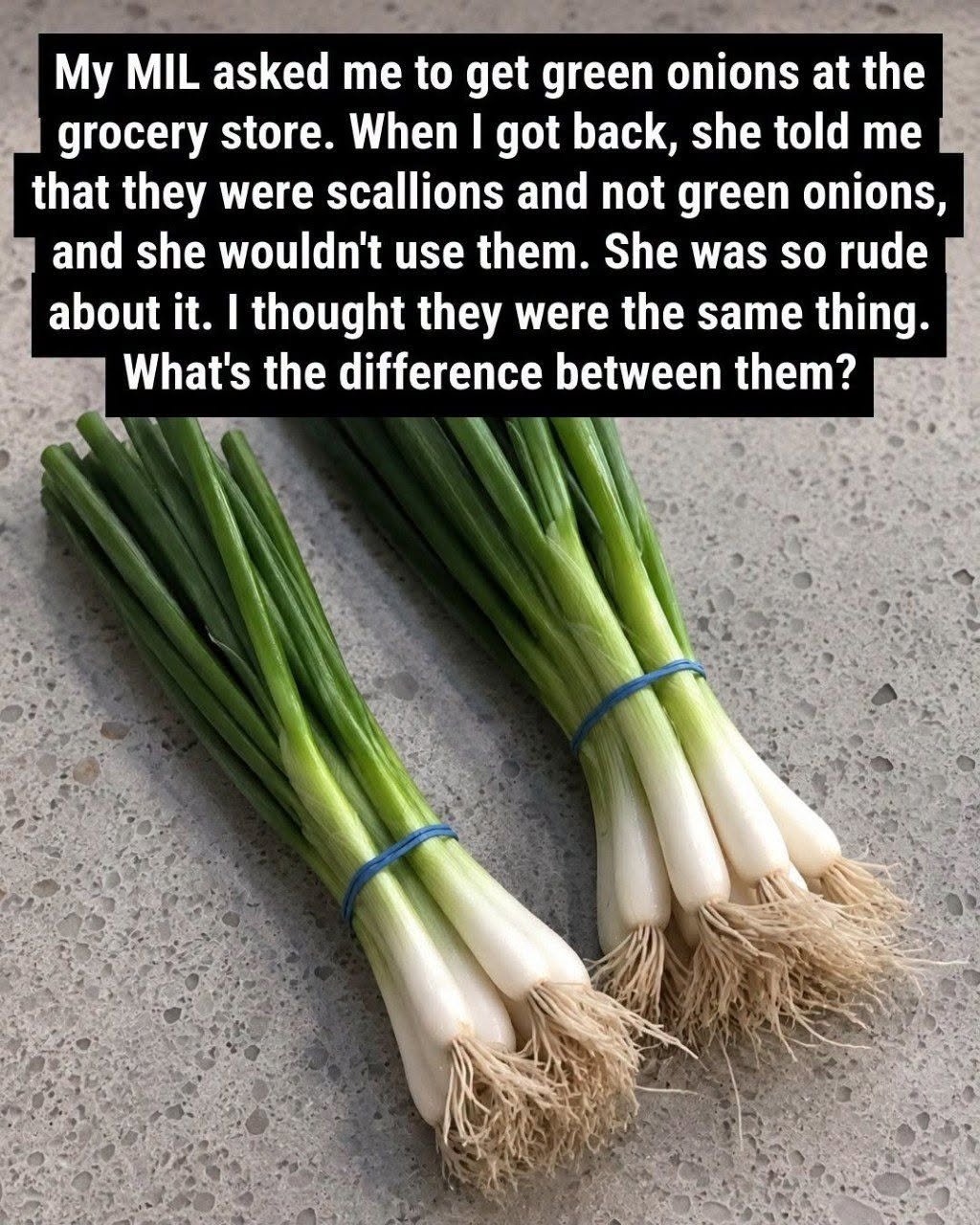
When it comes to cooking, the humble onion plays a crucial role in enhancing flavors and adding depth to a wide array of dishes. But if you’ve ever stood in the produce aisle staring at a bundle of long green stalks, wondering if the recipe meant “scallions” or “green onions” or “spring onions,” you are not alone. These terms are often used interchangeably, causing endless confusion among home cooks.
While these varieties share a similar family tree and a beautiful, crisp freshness, there are distinct differences that set them apart. Understanding these subtle nuances can elevate your everyday cooking from a simple meal to a comforting, flavorful experience.
Let’s explore the dissimilarities between scallions, green onions, spring onions, and chives, and discover how to use each one to bring out the best in your favorite family recipes.
🌱 What Are Scallions?
Let’s start with the slender, vibrant stalks that look like little green flags of spring. Scallions are young onions harvested very early, long before a bulb has a chance to form at the base. Because of this, the white part of the scallion is slim and uniform, matching the width of the green tops.
They have a mild, sweet, and crisp onion-like taste without the sharp bite of a mature onion. Scallions are incredibly versatile and are commonly used in both raw and cooked dishes. They add a fresh, bright crunch to salads, stir-fries, soups, and omelets. Usually, you’ll slice them diagonally, using every bit of both the white and green parts.
🧅 What Are Green Onions?
If you’re standing in the grocery store wondering if green onions and scallions are the exact same thing, the answer is: usually, yes! In most supermarkets, the terms “scallions” and “green onions” are used completely interchangeably to describe the exact same vegetable.
However, in some regions or at farmers’ markets, “green onion” might refer to a slightly more mature scallion. These might have a very tiny, slightly wider white base and a marginally stronger, more pungent flavor. They are a staple in Asian cuisines, particularly in Chinese and Korean dishes, where they are tossed into sizzling stir-fries, folded into dumplings, or sprinkled generously over comforting bowls of noodle soup.
🧅 What Are Spring Onions?
see to Next Page…
🧅 What Are Spring Onions?
Here is where the confusion usually peaks. While they look similar from a distance, spring onions are actually a different stage of growth.
Spring onions are left in the ground much longer than scallions or green onions. Because they have more time to grow, they develop a distinct, round, fully formed white bulb at the bottom—similar to a small, mature white onion. The green tops are still hollow and tender, but the white bulb is the star of the show.
How They Taste and Cook:
Because of that mature bulb, spring onions have a much stronger, sweeter, and more pungent onion flavor than scallions.
The Green Tops:
Can be used just like scallions for a fresh garnish.
The White Bulb:
Should be treated like a regular onion. Chop it up and sauté it as the aromatic base for soups, stews, and hearty casseroles, or slice it in half and roast it until it becomes meltingly sweet and caramelized.
🌿 What Are Chives?
Finally, we come to the delicate, elegant chive. Unlike the other three, chives are not an onion vegetable; they are a leafy herb.
They look like incredibly thin, hollow, dark green grass blades. They do not have a white bulb at all. When you cut them, they release a very mild, delicate, and slightly garlicky onion flavor. Because their flavor is so subtle, they are almost always used raw as a finishing garnish. If you cook them, they lose their flavor almost entirely.
💡 A Nostalgic Note:
For many of us, chives instantly bring to mind the nostalgic comfort of a classic egg salad on a slow, quiet morning, or a simple baked potato loaded with sour cream. They are the ultimate “finishing touch” that makes a humble dish feel like a special occasion.
🔄 The Substitution Guide: Can You Swap Them?
When a recipe calls for one, but you only have another in your fridge, don’t panic! Here is your cheat sheet for swapping these alliums.
If the Recipe Calls For…
You Can Substitute With…
How to Adjust
Scallions / Green Onions
Chives
Use them raw as a garnish. Because chives are milder, use a slightly larger handful. Do not cook them!
Scallions / Green Onions
Spring Onions
Use the green tops exactly as you would scallions. If using the white bulb, chop it finely and use less of it, as it is much stronger.
Spring Onions
Scallions / Green Onions
You can use them, but you will miss the sweet, roasted flavor of the bulb. Add a little extra regular yellow onion to the dish to make up for the missing bulb.
Chives
Scallions / Green Onions
Use only the very top, light green tips of the scallion. Finely mince them to mimic the delicate texture of chives.
see to Next Page…
For Complete Cooking STEPS Please Head On Over To Next Page Or Open button (>)